
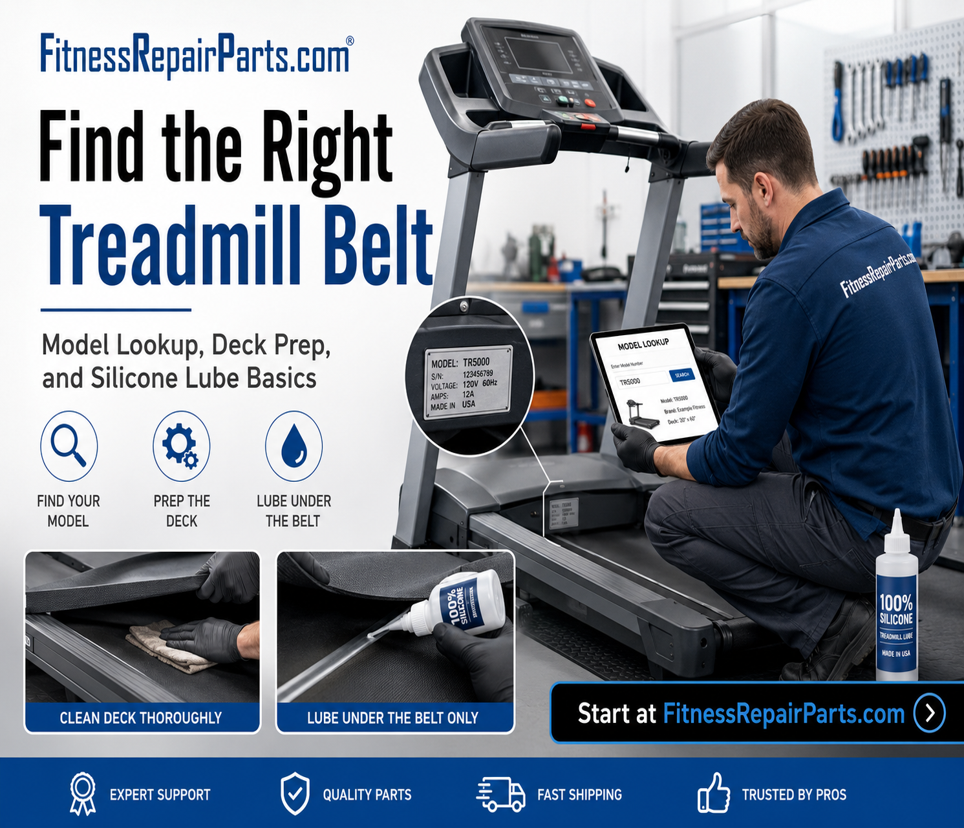
Treadmill Belt Replacement, Deck Prep and Lube Guide
When a treadmill hesitates, slips, or smells hot, the walking belt and deck are often the cause. Replacing a worn belt can restore smooth speed and protect expensive electronics, but only if you pick the exact part and prep the deck correctly.
This guide walks you through finding your model and serial information, confirming the correct belt, safely preparing the deck, choosing the right lubricant, and handling alignment and ordering like a pro. Whether you are a home user or facility tech, you will get a clean, repeatable process that fits the tools on FitnessRepairParts.com.
Start with Accuracy: Find the Model and Serial Label
Exact identification prevents returns and downtime. Look for the equipment label in these common treadmill locations:
- Under the frame, near the front or mid-chassis
- On the front stabilizer (front base)
- On the rear stabilizer (rear base)
Some legacy treadmills may hide the sticker inside a plastic shroud. Only remove covers if the label is not found externally. Safety first: unplug the treadmill, remove the safety key, follow the owner's manual, and consider a technician if unsure.
Once you have the brand, full model, and serial, use the site's manufacturer part number search and model lookup. Most model pages include exploded parts diagrams and parts lists so you can visually confirm the walking belt, drive belt, rollers, speed sensor, and hardware routing before ordering. If you have a manufacturer part number printed on the old belt, search it directly to jump to the exact match.
Tip: For NordicTrack, ProForm, and Life Fitness, start on the brand page, open your exact model, then verify the belt number and dimensions on the diagram and parts list.
Select the Correct Treadbelt on the Model Page
On the model's parts page, confirm:
- Any product-page fitment notes
- Warranty and lubrication requirements
Many standard treadbelts require fresh deck prep and a coat of lubricant. Product pages call this out and note that failure to prep and lube can void warranty coverage. If your unit uses a cut-to-length belt, measure carefully and match the model diagram; cut items are typically non-returnable once cut.
Essential Safety Checklist Before Any Work
- Unplug the machine and remove the safety key before you begin.
- Follow the owner's manual for covers, routing, and torque values.
- Completely clean the deck, rollers, and motor area. Do not spray liquids directly onto consoles, screens, or exposed electronics. Apply cleaner to a cloth first and keep moisture away from vents and seams.
- Use mineral spirits only where appropriate, in a well-ventilated area, and wear PPE as needed. Check the model's instructions for solvent guidance.
- Inspect the deck for grooves, burn marks, or delamination. Replace a worn deck before fitting a new belt.
- Check the treadmill drive belt and both rollers for glazing, wobble, or noise and replace if needed.
Deck Prep and Lubrication Basics
Most home and light-commercial treadmills that call for a liquid lubricant require a non-petroleum, 100% silicone product. Correct lubrication reduces friction at the belt-deck interface, helps prevent heat build-up, and can extend motor controller life. Popular options include Slik Stik and WalkNLube kits, which simplify application under the belt.
Important: Some models specify different lubrication or none at all. Always verify the lubrication type on your product or model page before applying anything.
After cleaning and inspecting the deck, install the new belt, then apply the specified lubricant per kit instructions. Even a new belt benefits from the correct lube on a clean, smooth deck surface.
Alignment and Tension, Plus Quick Fixes
After installation, center and tension the belt. FitnessRepairParts.com hosts an Adjusting Your Treadbelt tutorial you can follow for the step-by-step. Here are fast pointers and symptoms:
- Slip on foot strike: Add a quarter-turn of rear-roller tension evenly, then re-test. If the front drive belt slips, inspect and consider drive belt replacement.
- Drift to one side: Use small, equal adjustments on the rear-roller set screws to re-center. Make changes in tiny increments and re-test walking at 2 to 3 mph.
- Hesitation or surge: Verify lubrication, deck condition, and belt tension. Clean rollers and check for bearing noise.
If alignment requires constant correction, inspect for a worn deck surface, misaligned idler pulley, or a glazed drive belt.
Ordering Tips That Save Time
- Read stock indicators on item pages. You will see statuses like Currently In Stock, In Stock - Limited, On Order - Expected Soon, and Out of Stock. Backorders will be noted.
- For backordered items, consider contacting support for ETAs or alternatives. The company does not charge until orders ship.
- Cut-to-length belts and other cut items are typically non-returnable once cut; verify measurements and diagrams before purchase.
- Review product-page warranty and lubrication notes. Some belts require deck resurfacing and silicone lubrication for coverage.
Short FAQ
Is it worth replacing a treadmill belt?
Often yes. If the motor, controller, and deck are in serviceable condition, a new belt with proper deck prep and lubrication typically restores smooth performance at far less cost than a new treadmill.
How much does it cost to replace a treadmill belt?
Belt prices vary widely by size and model; many home units fall in the low to mid hundreds for the part. Labor and any needed deck or roller replacements are additional and can vary.
Can you replace a treadmill belt yourself?
Yes, if you are comfortable with mechanical work and follow the model-specific instructions. Always unplug the unit, remove the safety key, and use the site's diagrams. If uncertain, consult a qualified technician.
How do you know if a treadmill belt is worn out?
Look for slipping, hesitation, dark streaks or burn marks on the deck, a burnt-rubber smell, shiny or hard belt surfaces, or edges that fray. Excess heat or black dust around the front roller are additional clues.
How do you properly align a treadmill belt?
Use small, equal adjustments on the rear-roller set screws while the belt runs at a slow speed, then re-test. Reference the site's Adjusting Your Treadbelt tutorial for detailed steps.
What happens if you do not lube your treadmill?
Friction rises, which can wear the belt and deck prematurely, overwork the motor, and stress the motor controller. Proper lube reduces heat and extends component life when your model calls for it.
What kind of lubricant can you use on a treadmill belt?
If your model specifies liquid lubricant, use a non-petroleum, 100% silicone treadmill lubricant. Confirm the lubrication type on your model or product page before applying.
Helpful Links for Next Steps
- Browse silicone options and kits in treadmill belt lubricant to match your model's requirements.
- Explore drive belt replacement options if the front drive belt shows glazing or squeal.
- Find the correct walking belt by model or manufacturer part number using model number lookup and diagrams.
Summary
A smooth treadmill starts with accurate model identification, the exact walking belt, and a clean, properly lubricated deck. Unplug the unit and remove the safety key, confirm fitment on the exploded diagram, prep the deck, apply the correct non-petroleum silicone lube if specified, and finish with careful alignment. Handle stock and cut-to-length details before ordering to avoid delays. If anything looks questionable, reach out via Live Chat or consider a local technician for installation support.


