
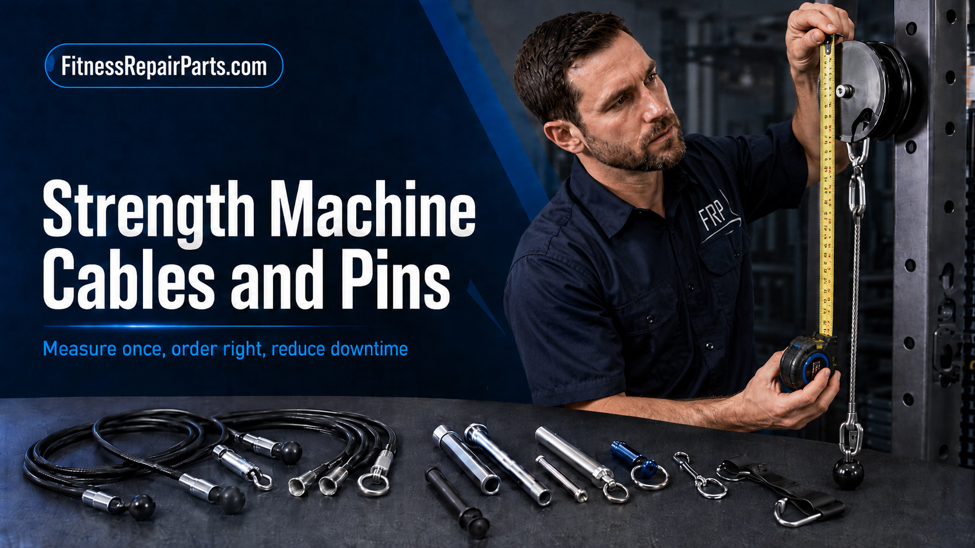
Strength Machine Cables and Selector Pins Replacement Guide
Downtime on a weight-stack machine is costly. A frayed cable or a missing selector pin can sideline a popular station and back up your floor. The fix is usually straightforward if you measure and verify the right details before you order.
This guide gives gym managers and service techs a clear, step-by-step playbook to identify and replace cable assemblies, pulleys, and selector pins correctly the first time. You will find measurement tips, end-fitting code definitions, pulley checks, and selector pin options, plus a printable checklist you can use on the floor.
Follow the owner's manual. If you are not comfortable performing the work, consult a qualified technician.
What to Gather Before You Measure
Start with documentation and IDs. The fastest path is to search by your equipment model number or a manufacturer part number, then confirm on the exploded diagram and parts list. Labels are often at the base of the frame. When you have the model, you can cross-check cable routing, pulley size, and hardware.
It also helps to take well-lit photos of:
- The full cable path and each end fitting
- Pulleys and their mounting bolts
- Selector pin and lanyard assembly at the weight stack
Keep a tape measure, calipers, a marker, and zip ties on hand.
How to Measure a Cable Assembly Accurately
Cut-to-length cables are typically non-returnable once cut, so accuracy matters. Use these steps:
1. Measure End-to-End
Remove the cable and measure overall length from the extreme end of one fitting to the extreme end of the other. Do not follow the frame or guess the path. Lay the cable straight and lightly tension it.
2. Identify Cable Diameter
Common gym cable sizes are 3/16 inch (about 4.8 mm) and 1/4 inch (about 6.4 mm). Use calipers on the bare cable, not over the jacket. If the jacket is intact, subtract the jacket thickness or check the owner's manual. If you ask, "what size is a gym cable?" most commercial weight-stack units use 3/16 inch; some heavy-duty stations use 1/4 inch. Always confirm on the machine.
3. Match the End Fittings by Code
Cable assemblies are defined by length and end-fitting types. Many catalogs use letters to denote fittings. Common examples include:
- A: bare cable end or plain cut
- B: ball end (small spherical stop)
- F: eye fitting (for a bolt or clevis pin)
- G: threaded stud
- K: stop sleeve or swaged stop
- L: loop with thimble
- O: open eye or fork/clevis style
- P: post or plug style fitting
- S: stud with shoulder or specific shoulder stop
Manufacturers may vary, so always compare your parts to the product page illustrations.
4. Confirm Thimbles and Stops
If your cable has a loop, identify whether it uses a thimble. If it ends in a swaged stop, note the shape and diameter. Mixing a different thimble size or stop profile can change effective length and create premature wear.
5. Inspect Wear Points
Look for broken strands, flat spots where the cable rides a pulley, and crushed jackets. Replace suspect pulleys along with the cable to avoid rapid re-failure.
If you need a ready-to-order match by model, review the exploded diagram for brands like Cybex, Life Fitness, Matrix, Parabody, and SportsArt and confirm the manufacturer part number. When in doubt, use model or manufacturer part number search and ask Live Chat for verification before ordering.
Pulley Verification: OD, Width, and Bore/ID
A noisy or tight cable path often traces back to the wrong pulley. Confirm:
- Outside diameter (OD) of the pulley
- Groove width and profile that matches your cable diameter and jacket
- Bore/ID size and bearing style (bushed, bearing, or sealed unit)
- Mounting hardware type and width between frame tabs, measure the ID (inside diameter) of the hole where the mounting bolt inserts through the pulley
A small OD or incorrect groove can pinch the cable, increase friction, and shorten life. If your machine shows chatter or drift after a cable swap, check pulley alignment and bearing condition. For exact pulley categories, see idler pulley replacement to compare OD and bore/ID while you have the unit open.
Selector Pins: Types, Lanyards, and Safety Checks
Selector pins do simple, critical work. A weight stack pin slides through the guide holes and engages the weight plate to select load. The collar or magnet helps seat and retain the pin so it does not back out during a set.
Common Types
- Magnetic selector pins: include a magnet to help hold the pin flush against the stack plate
- Pop-pin styles: spring-loaded detent that clicks into the plate
- Lanyard assemblies: tether the pin to the stack or shroud to prevent loss
Best Practices
- Match pin diameter and usable length to the plate and guide holes
- Inspect magnets, detents, and collars for wear or looseness
- Replace frayed or short lanyards, and route them so they do not snag
- Train users to seat the pin fully and verify engagement before lifting
Weight stack locks are simple lockout devices that block plate travel for service or to disable a station. Use them when working around the stack.
Can You Add Weight or Use Extender Pins?
You can add weight to a stack if the manufacturer provides adder plates designed for that model. Weight stack extender pins and third-party gym pins can work as add-ons, but they may change lever angles and increase stress on cables, pulleys, and guide rods. Overloading beyond design limits can accelerate wear or cause damage. If you are considering an extender, stay within the manufacturer's guidance, keep increments small, and increase inspection frequency. Do gym pins damage machines? Used within rated limits and with proper inspection, they typically do not, but misuse and overload can.
Lat Pulldown Form Reminders While You Are There
Since you are servicing the station, a quick form refresher helps protect new cables. Common lat pulldown mistakes include using too much momentum, leaning back excessively, pulling behind the neck, and letting the shoulders shrug up uncontrollably. Keep elbows angled slightly in front of your torso and pull toward the upper chest. Should your elbows be tucked in a lat pulldown? Tuck them toward your sides without pinning them; a natural path that tracks in front of your ribs typically protects shoulders and keeps tension on the lats.
Printable Measurement Checklist
Use this on the floor, then take a photo or print for records.
- Model and serial number from the frame
- Full cable path photo and each end fitting photo
- Cable overall length end-to-end (inches or mm)
- Cable diameter (3/16 inch or 1/4 inch typical) and jacket type
- End-fitting codes and details (A, B, F, G, K, L, O, P, S), note any thimble or stop size
- Pulley OD, groove width, and bore/ID; note bearing or bushing
- Selector pin diameter, usable length, type (magnetic, pop-pin), and lanyard condition
- Observed wear points and any parts to replace together
Remember, cut-to-length items are non-returnable once cut. Verify twice.
DIY or Call a Pro?
Can you replace a gear cable yourself? On weight-stack machines, many techs and experienced facility staff handle cable replacements in-house. If the routing crosses multiple pulleys, springs, or cams, or if you do not have tools to crimp fittings, use a pre-made cable assembly matched to your model or contact a professional.
Quick FAQ
How does a weight stack pin work?
It slides through a plate's guide hole and captures the plate on the selector shaft. A magnet or detent helps it stay seated under load.
Do gym pins damage machines?
Within design limits and with regular inspections, usually not. Overloading or poor form can damage cables, pulleys, or guide rods.
Can you add weight to a weight stack?
Yes, with manufacturer adder plates. Extenders can work, but keep within rated limits and inspect more often.
Do weight stack extender pins work?
They add load but may change leverage. Use cautiously and verify machine capacity.
How to identify cable size?
Measure bare cable diameter with calipers. Common sizes are 3/16 inch and 1/4 inch.
What size is a gym cable?
Most commercial stacks use 3/16 inch; some heavy-duty models use 1/4 inch. Confirm on your unit.
Can I replace a gear cable myself?
Many can, if the path is simple and a pre-made assembly is available. Complex routes may require a tech.
What are common lat pulldown mistakes?
Excessive lean, yanking with momentum, behind-the-neck pulls, and shrugged shoulders.
Should your elbows be tucked in a lat pulldown?
Tuck toward your sides with a natural forward track to protect shoulders.
What is a weight stack lock?
A device that blocks plate travel for service or to disable the station.
Find Exact Parts and Confirm on Diagrams
The fastest way to avoid downtime is to search by model or manufacturer part number, then confirm on the exploded diagram. You can browse weight machine cables and selector pins, or narrow directly to assemblies like a lat pulldown cable and verify end fittings and length. For pulley checks, compare options in idler pulley replacement and match OD and bore/ID to your notes. If you need brand-specific pages, review the brand like Life Fitness parts and confirm assemblies against your model page. If you are unsure, open Live Chat and share your measurements and photos for verification.
Summary
Measure once, order right, and keep your floor moving. Record cable length end-to-end, confirm diameter, match end-fitting codes, and check pulley OD and bore/ID. Choose the correct selector pin type, maintain lanyards, and use stack locks during service. When you are ready, search by model or MPN, confirm on the diagram, and use Live Chat if you want a second set of eyes. That little extra verification typically saves days of downtime.


