
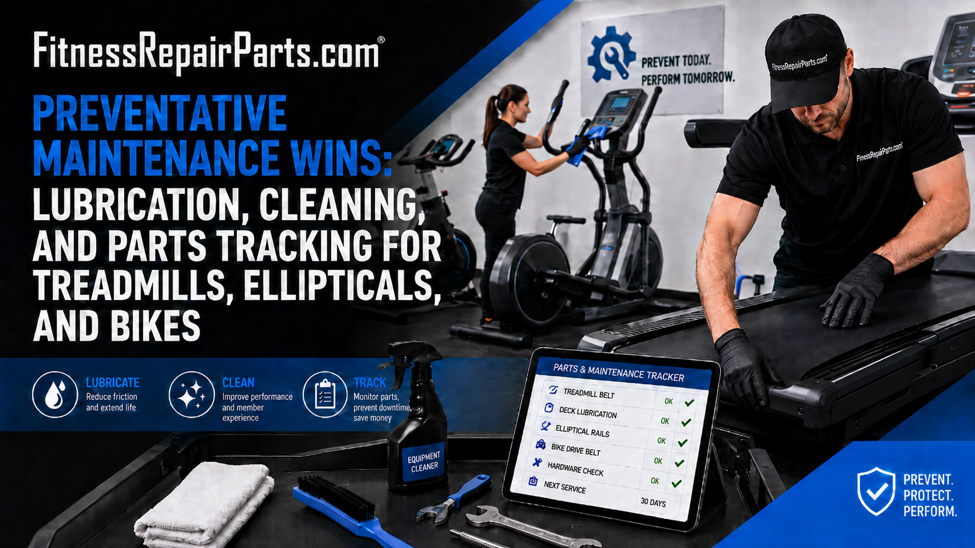
Preventative Maintenance for Treadmills, Ellipticals, and Bikes
Summer brings longer hours, busier gyms, and more miles on every machine. A short, smart maintenance routine now can prevent slowdowns, heat-related wear, and out-of-service signs when traffic spikes.
This guide gives you a practical seasonal checklist for home and commercial equipment. You will find what to lube, what to clean, when to inspect, and how to capture model and manufacturer part numbers so reorders take minutes, not days.
Safety first: unplug equipment and remove the safety key before servicing. Follow the owner's manual; if a step is unfamiliar, consult a qualified technician.
Treadmill Lubrication and Belt Care
Friction is the silent belt killer. A dry deck makes the motor work harder, creates heat, and shortens the life of the belt, deck, rollers, and motor controller. Higher friction can also increase power use, which may raise operating costs over time.
- What happens if you do not lube a treadmill: Expect belt hesitation, scorching or dark deck streaks, a burnt rubber smell, higher amp draw, and irregular speed. Left alone, this can damage the belt, deck surface, rollers, and electronics.
- Which oil is best: Use a non-petroleum, silicone-based treadmill belt lubricant specified by your model. Many treadmills require 100 percent silicone in liquid or gel form. Verify your model's spec.
- Can you use WD-40: Do not use WD-40 or other petroleum products on a treadmill belt or deck. Petroleum attracts dirt, degrades belt materials, and can void warranties.
- Will any silicone product work: Not always. Use a treadmill-ready silicone formula and follow your manufacturer's instructions for amount and interval.
How to Lube, in Brief
- Unplug power and remove the safety key. Lift the belt slightly at mid-deck.
- Apply the specified silicone along both sides, centered where your feet land.
- Rotate the belt by hand to spread, then run the treadmill at slow speed with no load for several minutes. Wipe excess.
Deck Resurfacing and Pairing with New Belts
- If the deck shows grooves, glazing, or burns, resurface or replace the deck when you replace the belt. A worn deck can ruin a new belt quickly.
- Before installing a new treadmill belt, give the whole treadmill a thorough cleaning. Clean the deck, rollers, underside of the belt path, and motor area so dust, old residue, and debris do not shorten the life of the new belt.
- Use appropriate cleaners and ensure good ventilation if solvents are needed.
Alignment and Tension
- A belt drifting to one side typically indicates alignment or tension issues. Use the rear roller adjustment bolts in small, equal turns per your manual to center the belt. Do not overtighten; over-tension creates heat and wear.
- To stop slipping, first confirm proper deck lubrication, then set tension so the belt does not stall under footfall at moderate speed. If slipping persists with correct lube and tension, inspect the drive belt for glazing and the front roller pulley for wear.
Replacement Intervals
How often to replace a treadmill belt varies by use and quality. Home use often ranges from 3,000 to 7,000 miles; commercial belts can wear faster under high load. Replace sooner if you see fraying edges, stretching, hard glazing, persistent slip after proper tensioning, or if amp draw remains high on a freshly lubed deck.
If you need a new walking belt or a model-specific lubricant, browse treadmill belt options and lubricants, then confirm fit on your model page and exploded diagram. You can explore treadmill belt lubricant options at our lubricant category and review treadmill belts by size and model.
- Explore lubricants – find treadmill-ready silicone in our lubricant category.
- Review belts – compare sizes and confirm fit on your model page.
Ellipticals and Bikes: Cleaning, Pivots, and Drive Systems
Ellipticals
- Wipe rails, wheels, arms, and other non-electronic surfaces with an equipment-safe cleaner appropriate for the material.
- Never spray liquids on consoles, screens, control panels, or other electronic areas. For those surfaces, follow the manufacturer's instructions and apply any approved cleaner to a cloth only, and only on sealed areas where approved.
- Inspect weekly: roller wheels, track rails, pedal bolts, and all pivot points. Listen for squeaks or clicking that can signal a worn bearing, bushing, or idler pulley.
- Quarterly: check crank-arm fasteners, linkage hardware, and drive belt condition. A glazed or cracked drive belt can chirp or slip under load and may require replacement.
Stationary and Air Bikes
- Clean frames and grips with equipment-safe products suitable for the surface.
- Never spray liquids on consoles, screens, or electronic controls. Follow the manufacturer's instructions and use approved cleaning methods on sealed areas only.
- Monthly: check pedal straps, seat adjustment hardware, and bearings for play. Replace stretched straps and worn bearings to keep riders safe and comfortable.
- Chain-driven bikes need chain inspection and lubrication per the manufacturer; belt-driven bikes need drive belt tension and wear checks.
- On bikes and ellipticals, excess friction in bearings, belts, chains, rollers, or pivots can also increase resistance on the system and add to operating costs over time.
Non-Slip Safety
For high-traffic areas and step-on points, apply non-slip tape to reduce slip hazards, especially after deep cleaning.
Cleaning Protocols That Protect Equipment
- Daily disinfect: Clean high-touch surfaces according to the manufacturer's instructions.
- Never spray liquids directly on consoles, screens, or electronic control areas. Use only approved methods and products, and only on sealed areas where permitted.
- Simple Green: Suitable for many non-electronic surfaces when diluted as directed. Always check product notes and manufacturer guidance to avoid harming plastics, coatings, or display surfaces.
- Technique: Apply cleaner to a towel rather than directly to the equipment unless the manufacturer instructs otherwise. Keep moisture away from openings, seams, and unsealed electronic areas, then dry surfaces after wiping.
- Ventilation: When using solvents for deck prep or degreasing, work in a well-ventilated area and wear appropriate personal protective equipment.
- Do not substitute petroleum products on belts, decks, or bushings that specify silicone or dry-film lubrication only.
Summer Inspection Intervals and Parts to Watch
Create a simple rotation to prevent surprises:
Weekly
- Treadmills: belt alignment, deck lube check, safety key function test.
- Ellipticals: roller track cleanliness, pivot noise check.
- Bikes: pedal strap condition, seat clamp tightness.
Monthly
- Bearings and bushings: check for noise, play, or roughness on rollers, pulleys, and pivot points.
- Cables: inspect for fraying, kinked sections, or damaged housings on home gyms and selectorized equipment.
- Drive belts: inspect treadmill and elliptical drive belts for glazing, cracks, or slack.
Quarterly
- Deep clean under motor shrouds and cooling vents; clear lint and dust.
- Recheck deck condition and amp draw on treadmills after lubrication.
- Confirm console buttons and safety interlocks work reliably.
When a drive belt shows glazing or persistent chirp after tensioning, plan a drive belt replacement matched to your exact model. You can review drive belts here: drive belt replacement.
Parts Tracking: Model Numbers, MPNs, and Faster Reorders
Accurate model and manufacturer part numbers (MPNs) cut search time dramatically.
Where to Find a Model Number
- Look for a label under the frame, on the front stabilizer, or on the rear stabilizer. Some older treadmills may hide labels under plastic shrouds; if you must remove covers, unplug the unit, remove the safety key, and follow the owner's manual.
How to Check a Manufacturer Part Number
- On parts themselves: larger components, consoles, motors, and boards often have a sticker with the MPN.
- In the owner's manual: parts lists sometimes include manufacturer numbers.
- On the site: use our cross-reference to search by MPN or model, then confirm on the exploded diagram and parts list.
Recordkeeping Tips for Teams
- Keep a shared log with brand, full model number, serial number, and room location.
- Add MPNs for wear items like walking belts, drive belts, safety keys, roller wheels, bearings, and cable assemblies.
- Note stock status when ordering. Our item pages display inventory indicators such as Currently In Stock, In Stock - Limited, Out of Stock, or On Order - Expected Soon so you can plan replacements.
- Maintenance logs can also help teams document inspection dates, completed service, and recurring issues across each machine.
- You can also track your inventory with our FREE Stock Stock Inventory Management System if you have a FRP account: Inventory Management System.
Use our model and MPN cross-reference to locate exact matches fast. Try the manufacturer part number search or model number lookup at part search.
Quick Checklist for Summer Readiness
Treadmills
- Lube the deck with manufacturer-specified silicone, never WD-40.
- Center and tension the walking belt; verify safety key function.
- Inspect the drive belt for glazing and vacuum dust from motor shrouds.
Ellipticals
- Clean rails and wheels; check pivot bushings and bearings.
- Verify drive belt condition and crank-arm fasteners.
- Address squeaks that suggest idler pulley or bearing wear.
Bikes
- Clean grips and consoles only as the manufacturer allows.
- Check pedal straps, seat hardware, and bearings; replace as needed.
- For chain drives, lube per manual; for belt drives, inspect tension and wear.
FAQ: Fast Answers to Common Treadmill Questions
What happens if you do not lube your treadmill?
Friction rises, causing hesitation, heat, damage to the belt, deck, and rollers, and higher amp draw that can shorten motor and controller life.
Which oil is best for a treadmill belt?
A non-petroleum, treadmill-specified silicone lubricant, per your model's instructions.
Can you use WD-40 to lube a treadmill belt?
No. Avoid WD-40 and all petroleum products on belts and decks.
Will any silicone lubricant work?
Use a treadmill-approved silicone. Some models specify liquid, others gel or wax; follow the manual.
How often should a treadmill belt be replaced?
It varies by use and quality; many home users see 3,000 to 7,000 miles. Replace earlier if you see fraying, glazing, or persistent slip after correct tension and lube.
How do you stop a treadmill belt from slipping?
Lube the deck correctly, then set belt tension per the manual. If it still slips, inspect the drive belt and front roller pulley.
Why is the belt sliding to one side?
The rear roller usually needs a small alignment correction; adjust evenly and test at slow speed.
What are the main treadmill parts called?
Typical assemblies include the walking belt, deck, front and rear rollers, drive motor, motor controller, drive belt, speed sensor, safety key, console, and side rails.
Where to Get Help and Next Steps
- Identify your model and any MPNs, then confirm parts on your equipment's exploded diagram.
- Check stock status before ordering so you know what is ready to ship.
If you are lining up summer spares, start with essentials like walking belts, drive belts, safety keys, cable assemblies, bearings, and pedal straps. You can browse complete categories and brand pages when you are ready. For example, see elliptical machine pages.
Summary
A light, regular maintenance routine prevents most mid-season issues. Keep belts lubricated with the correct silicone, clean high-touch surfaces according to manufacturer guidance, and inspect moving parts on a schedule. Record model and part numbers so reorders are quick, confirm on exploded diagrams, and check inventory status. Keeping clear maintenance logs alongside those records can make routine service easier to track across multiple machines. Lower-friction equipment also tends to run more efficiently, which can help reduce unnecessary operating costs over time. If questions come up, use our model and MPN cross-reference to verify the correct part before ordering.


